
Owners often wait to think seriously about exit planning until a sale, succession, or retirement starts to feel close. By then, some of the most important value-building work may already be harder to accomplish. Exit planning works best when it begins before the owner feels ready to leave.
Starting early means building a business and personal plan that can support a sale, internal transition, family succession, or unexpected opportunity when the time comes. For most owners, that means beginning several years before they expect to exit. The sections below explain why that timeline matters and what planning can look like at each stage.
How Early Should You Start Thinking About Exit Planning?
A useful planning window is often three to five years before a preferred exit and earlier can be better when the business depends heavily on the owner, family succession is being considered, or value needs to be improved before a sale. Starting early does not mean the owner has to leave soon. It means there is time to strengthen the business, clarify personal financial needs, prepare key people, and evaluate realistic exit paths before the timeline becomes compressed.
For example, an owner who wants to sell in five years may discover that most customer relationships still run through them. With time, those relationships can be transferred, leadership can be developed, and the business can become less dependent on one person.
When Is It Too Late to Start Exit Planning?
It is too late to get the full benefit of exit planning when the owner is already forced into a transaction, dealing with a health issue, responding to partner conflict, or negotiating with a buyer before the business is ready. Planning can still help at that point, but the options may be narrower.
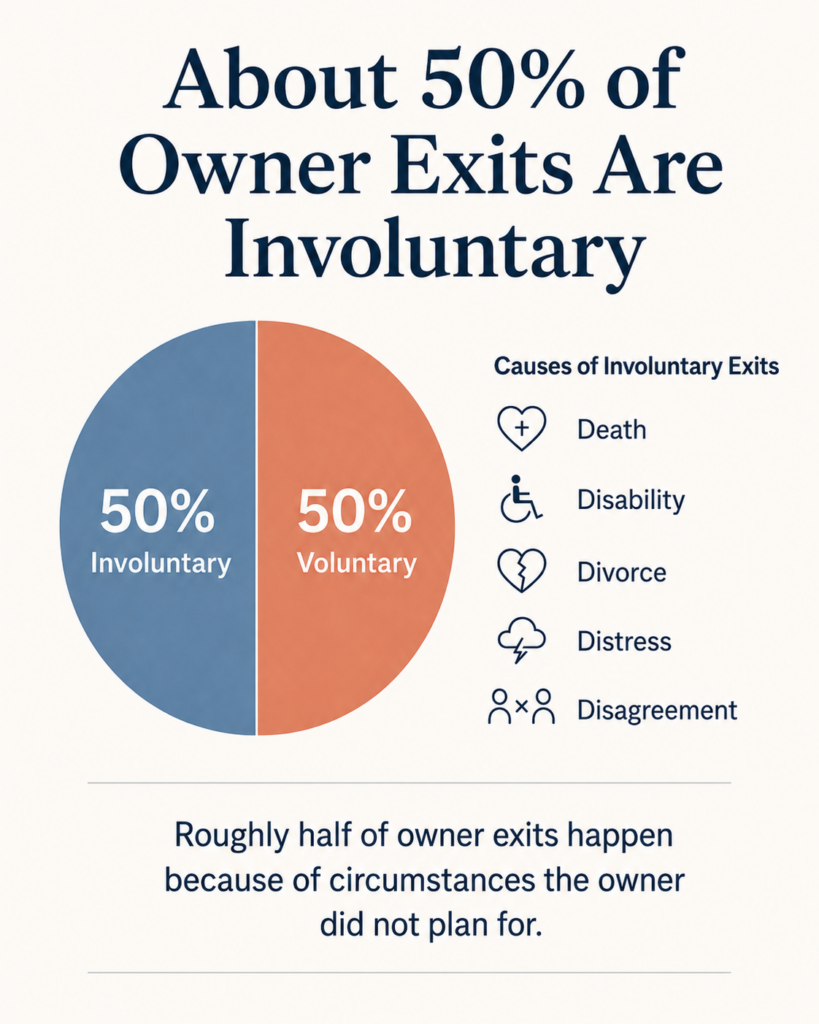
That matters because a significant number of exits do not happen on the owner’s preferred timeline. Exit Planning Institute has reported that roughly 50% of owner exits are involuntary due to death, disability, divorce, distress, or disagreement. A plan started early gives the owner more control. A plan started in crisis often becomes damage control.
When Should You Bring In Professional Exit Advisors?
Professional advisors should be brought in once the owner is seriously thinking about value, timing, succession, sale options, tax exposure, personal financial independence, or family impact. That does not have to mean the business is for sale. It means the decisions are connected enough that they should not be handled in isolation.
This is especially important when multiple advisors are already involved. The CPA may be focused on tax, the attorney on agreements, the investment advisor on personal assets, and leadership on operations. An exit planning process helps connect those perspectives so the owner can understand how business value, personal wealth, estate planning, and transition goals affect one another.
What a Typical Exit Planning Timeline Looks Like
The exact timeline will depend on several factors specific to your situation. However, what we’ve generally seen across our decades of service is:
- Five or more years out: Define personal goals, estimate business value, review financial independence needs, identify owner dependency, and begin improving transferability.
- Three to five years out: Build leadership depth, strengthen financial reporting, reduce customer or employee concentration, review buy-sell agreements, and clarify likely exit paths.
- One to three years out: Prepare the business for a sale, family succession, management buyout, or internal transition. Address tax strategy, estate planning, key employee retention, and liquidity needs.
- Six to twelve months out: Coordinate the transaction or transition team, finalize planning documents, prepare communication plans, and review the owner’s post-exit financial plan.
- At transition: Support decision-making, advisor coordination, family communication, and the movement from ownership into the next stage of the plan.
How to Know If Your Business Is Ready
Always consult with a professional advisor before making your exit. However, the following signs usually indicate your business doesn’t have excessive owner reliance and may be ready for you to step away:
- The business can operate without the owner driving every major relationship or decision.
- Financial records are clear, current, and understandable to a buyer or successor.
- Leadership is prepared to run the company through change.
- Key employees have reasons to stay after the transition.
- Customer concentration, vendor risk, and owner dependency have been addressed.
- The owner understands how much value is needed to support life after exit.
- Estate, tax, insurance, and liquidity planning have been reviewed.
- The preferred exit path has been tested against business reality.
How Waiting Too Long on Planning Hurts Business Value
Waiting too long can make the business harder to transfer and less attractive to buyers or successors. Problems that could have been addressed over time, such as weak leadership depth, outdated agreements, unclear financial reporting, or heavy owner dependency, may become value issues during a transaction.

This is one reason the sale process can disappoint owners. Exit Planning Institute reports that only 20% to 30% of businesses that go to market actually sell. Readiness matters. A profitable business is not automatically a transferable business, and a strong company on paper may still raise concerns if the buyer believes too much value depends on the owner staying involved.
Do Exit Planners Assist with the Point of Business Transition?
Yes. Exit planning is not only about the years leading up to a sale or succession event. It can also support the actual point of transition by helping coordinate advisors, clarify decisions, prepare the owner and family, and connect the business transaction to the personal financial plan.
That support can be especially valuable because business exit decisions rarely happen in one lane. A sale may affect estate planning, tax strategy, investment management, insurance needs, charitable goals, and family expectations. Erben Associates helps owners prepare for those intersections so the transition is not treated as a single event, but as part of a broader business, wealth, and legacy plan.
What’s the First Step to Take in Exit Planning?
The first step is not choosing a buyer, naming a successor, or setting a final exit date. It is understanding where you stand today. That means clarifying what the business may be worth, how dependent it is on you, what your personal financial needs may be after exit, and which transition paths are actually realistic.
From there, planning becomes more useful. You can see whether the business needs work before a sale, whether family succession is practical, whether key employees need to be retained, and whether your estate, tax, investment, and liquidity plans support the outcome you want.
Erben Associates helps business owners begin with that broader view. We help evaluate business readiness, personal financial goals, succession options, and the planning gaps that may need attention before a transition becomes urgent.