
Get Your Business Value with BizEquity
A clearer way to understand what your business may be worth
For many business owners, the business represents years of work, leadership, sacrifice, and decision-making. It may also be one of the largest pieces of your personal wealth. Yet many owners do not have a current, structured estimate of what the business may be worth or how that value fits into their long-term plans.
BizEquity is a business valuation tool Erben Associates uses to help business owners begin that conversation. The tool provides an estimated valuation of a privately held business and helps identify the factors that may be influencing that value. The result is not just a number. It is a starting point for better planning.
Get Your Business Valuation Estimate Now
BizEquity is an online business valuation platform designed for privately held companies. It uses information about your business, financial performance, industry, assets, liabilities, operations, risks, insurance coverage, and ownership goals to create an estimated business valuation.
The tool can help owners better understand what their business may be worth today and what factors may affect value over time. It can also help connect business value to larger planning conversations, including exit planning, succession, insurance, estate planning, and financial independence.
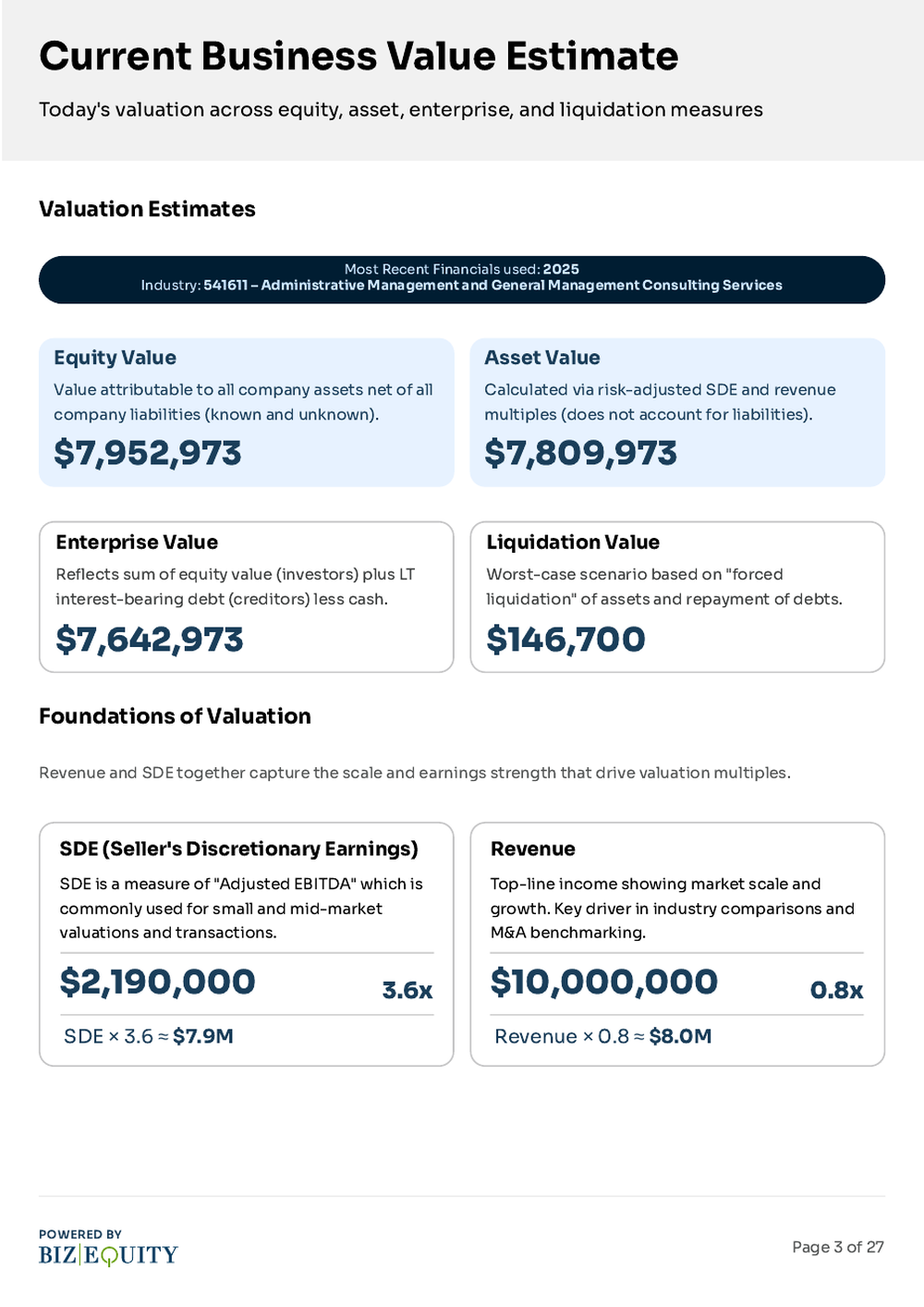
Business owners often track revenue, profit, expenses, and growth, but business value is not always reviewed with the same consistency. That can create blind spots.
A current valuation can help you think more clearly about questions such as:
- Is the business value aligned with my long-term financial goals?
- What would I need the business to be worth in order to exit on my terms?
- What risks could reduce value or limit future transition options?
- Is the business too dependent on me or another key person?
- Are my buy-sell agreement and insurance coverage aligned with current value?
- How does the business fit into my estate, gifting, or legacy planning?
- What planning steps should be addressed before a sale or succession becomes urgent?
Even when a transition is years away, valuation can help create a clearer baseline for future decisions.
The BizEquity process begins with a structured set of questions about the business.
Depending on the situation, information may include:
- Business name, industry, location, ownership structure, and tax form
- Revenue, pretax income, owner compensation, interest expense, and add-backs
- Assets, liabilities, cash, inventory, fixed assets, debt, and contingent obligations
- Growth expectations, recurring revenue, profit margins, and operational trends
- Customer concentration, intellectual property, owner dependence, and other risk factors
- Real estate ownership or lease information
- Existing insurance coverage, including buy-sell, key person, disability buyout, and business overhead coverage
- Minority ownership considerations
- Target exit value, desired transition timing, and preferred transition strategy
- Owner, officer, and related-party compensation information
The more complete the information, the more useful the valuation discussion can become.
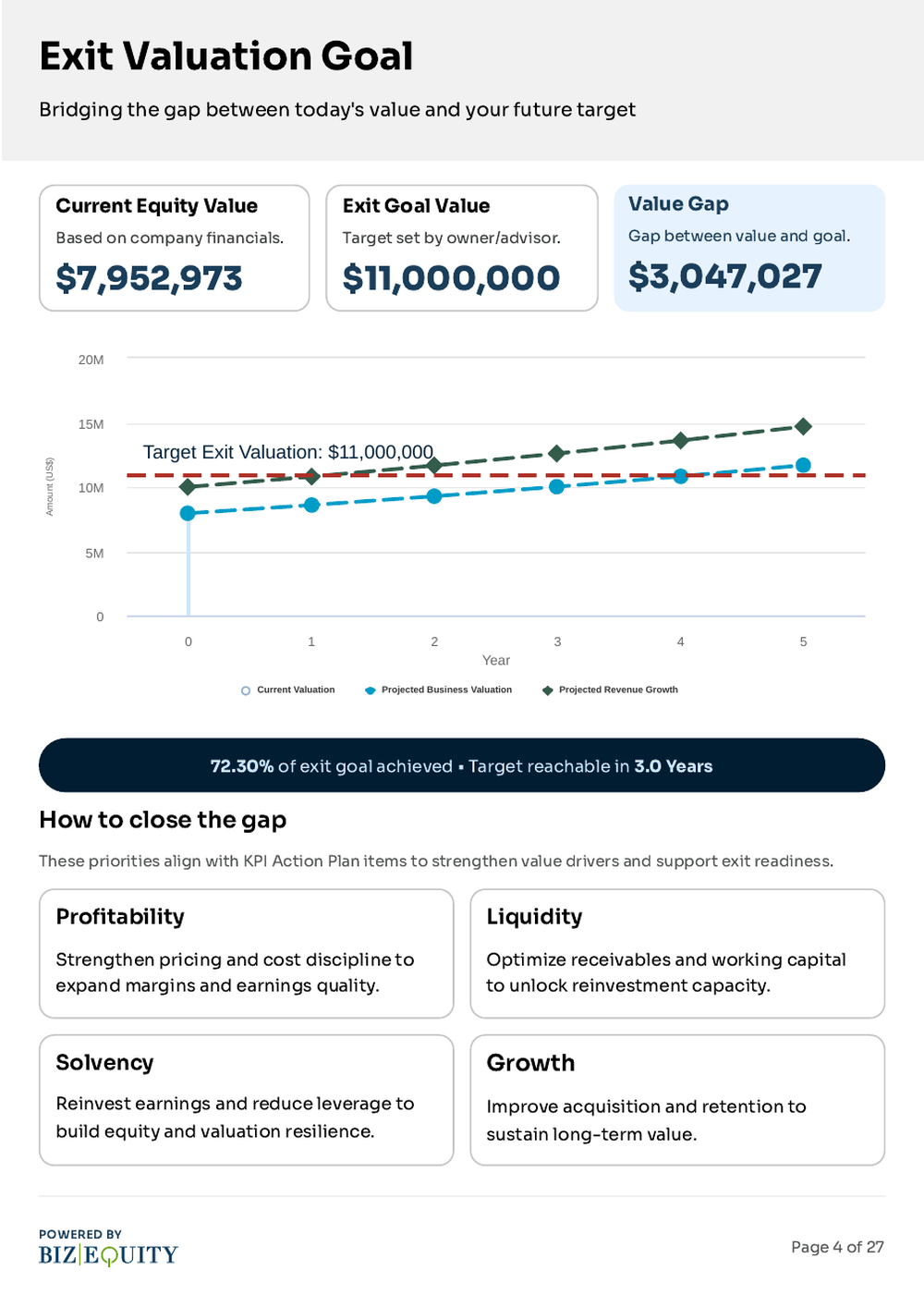
A BizEquity report may include several views of business value, including equity value, asset value, enterprise value, and liquidation value. It may also provide insight into financial performance, industry benchmarks, value drivers, risk factors, insurance gaps, ownership considerations, and the gap between current value and a future exit goal.
In practical terms, the report can help identify:
- Current estimated business value
- Key drivers influencing value
- Areas where the business may be underperforming or outperforming industry benchmarks
- Risks that may affect future value or transition readiness
- Insurance gaps tied to business continuity or ownership transfer
- How current value compares to a target exit value
- Planning opportunities related to succession, exit strategy, estate planning, or financial independence
This can be especially helpful for owners who have not recently valued the business or who are beginning to think more intentionally about what comes next. Click here to view a sample Business Valuation Report.
Erben Associates uses BizEquity as a planning resource, not as a standalone answer. The tool helps establish a baseline, but the real value comes from interpreting that baseline in the context of your goals.
After the valuation is complete, Erben Associates can help you understand what the results may mean for your broader planning. That may include discussions around business valuation, readiness assessment, business exit planning, succession planning, buy-sell agreement design, key person insurance, estate planning, and personal financial independence.
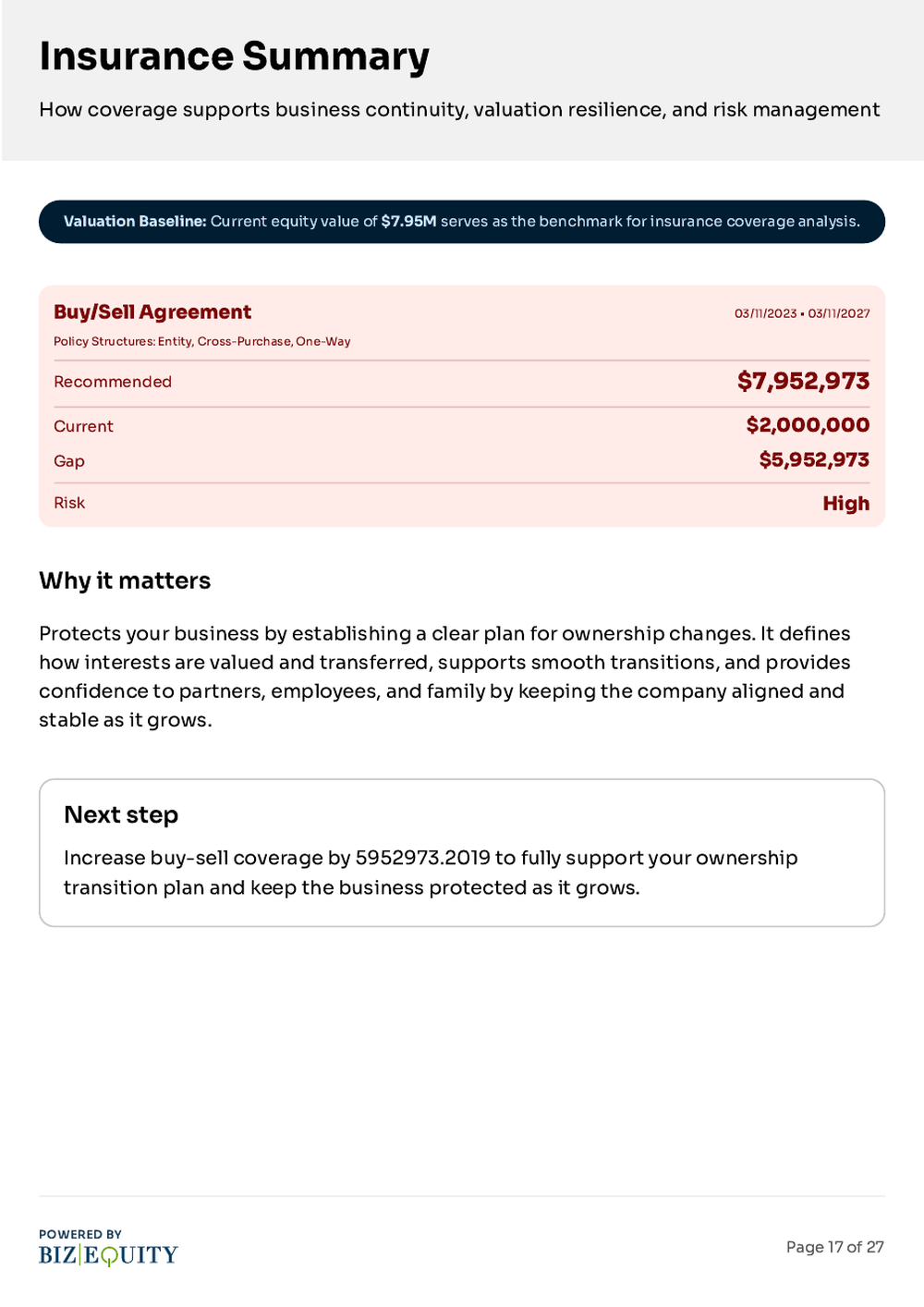
For example, a valuation may reveal that the business is not yet worth what you would need for a future exit. It may show that insurance coverage has not kept pace with current business value. It may highlight owner dependence, customer concentration, or other risks that could affect transferability.
Those insights can help guide the next planning conversation.
BizEquity may be helpful for owners of privately held businesses who want a clearer understanding of their current position.
It may be especially useful when you are:
- Beginning to think about a future exit
- Reviewing succession options
- Updating a buy-sell agreement
- Evaluating key person or buy-sell insurance needs
- Considering a family transfer, internal transition, or third-party sale
- Preparing for estate, gifting, or legacy planning
- Trying to understand whether the business can support your financial independence goals
- Looking for a regular baseline to track business value over time
You do not need to be preparing for an immediate sale. In many cases, the best time to understand business value is years before a major transition.
Waiting to get your business value until it’s time to leave can limit your options or reduce your business appeal. Start a conversation with us to get a better picture of where you are today, and what you need to work towards.
BizEquity provides an estimated valuation for planning purposes. It is not a formal appraisal, tax opinion, legal opinion, fairness opinion, or guarantee of future transaction value.
Actual business value can be influenced by market conditions, buyer demand, deal structure, industry trends, financial performance, tax considerations, leadership depth, customer concentration, and many other factors.
The report should be viewed as a starting point for discussion, not a final determination of value.